
in joseon seoul there was both a north village (bukchon) and a south village (namchon). while namchon stretched from the cheonggyecheon south to nam mountain and was home to lower ranking officials, bukchon was built between gyeongbuk and changdeok palaces, and was historically home to fancy palace officials.

the palaces were built on what was considered seoul's two best plots. according to korean baesanimsu (배산임수) principles (similar to feng shui), their location is auspicious since it sits on the slopes of a mountain (bugaksan) with water (the cheonggyecheon and the han river) in the front. situated in-between, bukchon also enjoyed the area's positive yang energy. while little of namchon remains, bukchon is seoul's last neighborhood with a high concentration of traditional homes, called hanok (한옥). according to peter bartholomeu, there were over 800,000 hanoks in seoul just thirty years ago, but today only some 12,000 remain with 900 concentrated in bukchon.

hanok are typically single-story structures made of clay, wood and stone with ondol heated floors topped by curved tile roofs called giwa (기와). in this part of korea, they usually take the shape of the korean letter "geok" (ㄱ) or "deegut" (ㄷ), which create a nice central courtyard. in the cold north they are often square shaped to help retain heat, while the warmer southern region's hanok can have an open "I" shape.

today there are about 2,300 homes in bukchon, but back in the day there were probably no more than 30 villas here. but when japanese annexation brought the joseon dynasty down in 1910, social and economic forces conspired to divvy up of the old villas into hundreds of compact lots. unfortunately, what remains is only about 40% hanok (down from 55% in 1985), and very few of them date from the joseon period. most were mass produced in the 1930s, and space restrictions required shorter roof eaves and the average hanok in bukchon is only about 25 pyeong in size (about 83 sq m / 900 sq ft) although there's one 150-pyeong monster hanok.

bukchon hasn't escaped a government policy to tear down hanoks, or the desire of many koreans to abandon their "inferior" traditional housing for the sea of ubiquitous "apateu" tower blocks that started ravaging seoul's skyline in 1962. while just 10% of seoulites lived in community housing in 1970, a generation later (by 1994), nearly 60% did.

it's only recently that the city government and tourism officials realized bukchon's value and moved to protect it. unfortunately, their preservation plans have been plagued with snafus. while the neighborhood has been better preserved than most (this isn't saying much), it's nearly impossible to find a view uninterrupted by ugly, new-ish, multi-story brick homes. for example, even though the gahoe-dong neighborhood was designated a hanok preservation district in 1973 and put under special care of the city, less than half of its hanoks remain.

by 2000 there were just two streets in gahoe-dong filled entirely by hanoks. in 2001, the seoul metropolitan government launched its "bukchon project", investing 84-billion won ($90 million) to encourage residents to register and renovate hanoks via grants and low-interest loans. the city undertook a detailed architectural survey and worked to improve roads, street lighting and tourist signage while changing zoning laws and imposing new height and design restrictions.
the problem, however, was that large areas in west bukchon were excluded. through 2007, while 200 neighborhood hanoks were renovated, many others were demolished and replaced with 4-story+ commercial buildings. furthermore, while bukchon maintains its tenuous definition as a primarily residential neighborhood, its population is only about half of what it was in 1976. furthermore, in 2006 alone, 33 homes were converted into commercial establishments.

while the number of hanoks in bukchon continues to fall, there's also new hanok construction going on. living in a hanok is becoming cool, and the city is working hard to promote bukchon as a top tourist destination. the rise of wine bars and art galleries in trendy, next-door samcheong-dong, brings a lot of foot traffic, not least of which is japanese housewives on "yonsama" pilgrimages. "yonsama" is the japanese name given to bae yong-joon, the (gross) star of the very popular korean tv drama, "winter sonata", which was filmed in bukchon.
not your thing? then pick up a neighborhood map at the bukchon cultural center and partake in the new "bukchon museum freedom pass". for 10,000-won, you get access to five museums: the gahoe museum, hansangsu embroidery museum, dong-lim museum, museum of korean buddhist art, and my favorite, the seoul museum of chicken art.

as hanoks continue to be demolished in other parts of seoul, at least one neighborhood's clumsy efforts to preserve them is gaining traction. let's hope bukchon's sea of arching tile roofs and winding alley roads stick around to see seoul's next iteration.
getting there:→ take subway line 3 to anguk station (exit #2) and walk north. the area's museums are typically open 10:00-18:00, closed mondays.
more info:
"the bukchon plan" (in korean)
"the bukchon plan" translated into english


30 July 2008
field trip #13: bukchon (북촌)

19 June 2008
field trip #12: deoksu palace (덕수궁)

three months ago during a raskb walking tour of seoul's palaces, i learned that before most of seoul's five grand palaces were burned or bulldozed, they formed asia's second largest royal compound (the largest was china's forbidden city).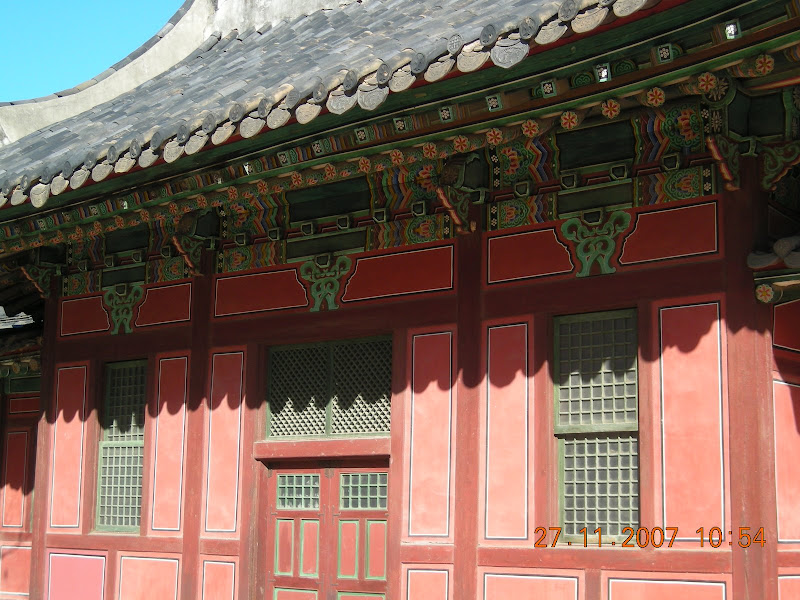 pretty in pink.
case in point is the "palace of virtue and longevity," better known as deoksugung, or deoksu palace. located in the middle of modern seoul, it was built during the mid-1400s as a private villa for prince wolsan, the big brother of king seongjong. but when the japanese invasion of 1592 left all of hanyang's (now seoul) palaces burning, the residence was renamed gyeongungung and converted into a temporary palace for just 7 years until changdeok palace took over. the ole villa-cum-palace fell into disuse over the next 2+ centuries before it became emperor gojong's official residence in the 1890s. my guide estimated that at its height, deoksugung was comprised of 180 structures, but most were either burned in a 1904 fire or demolished by the japanese during the colonial period. today, only about 12 significant buildings remain on a footprint whose size is less than half its original. nevertheless, what remains is a beautiful reminder of the sophistication of korea's joseon period. 
in the years immediately pre- and post japanese annexation of korea, the palace was the site of fascinating political intrigue and tragedy as gojong and his remarkable wife, empress myeongsong, juggled the imperial designs of four world powers: china, japan, russia and the united states (such has always been korea's fate thanks to geography). when the empress was brutally murdered by the japanese in 1895, gojong went into safe-keeping at the nearby russian legation before returning to the palace in 1897 (albeit with a secret tunnel connecting his palace to the russians).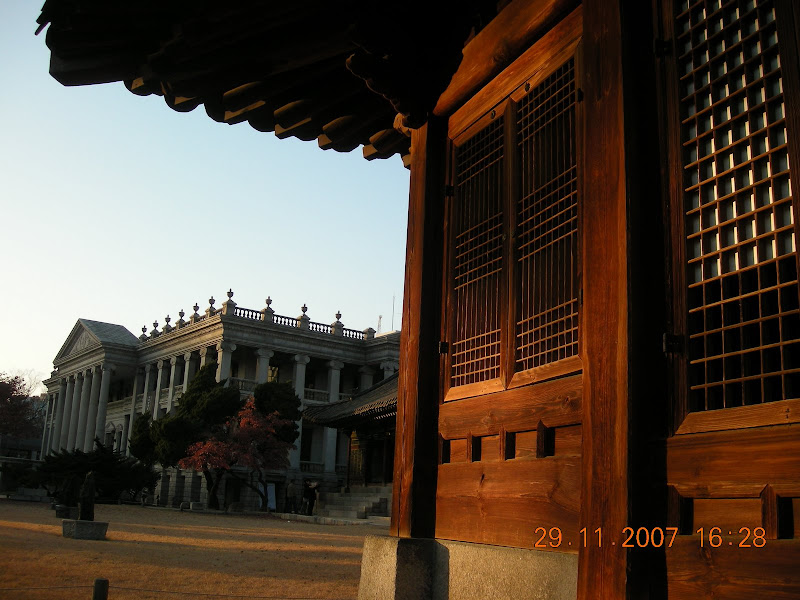 sunset on seogeodang with the neo-classical seokjojeon in the back.
but japanese defeats of the chinese in the 1894-5 sino-japanese war and the russians in 1904-5, along with secret deals with the americans and brits (also in 1904-5), korea's fate was sealed. at the conclusion of the portsmouth peace conference in september 1905, japan demanded that "korea be placed at japan's free disposal". in a desperate effort to preserve his country, gojong sent a personal letter to u.s. president theodore roosevelt, who refused it. alone and at the point of a bayonet, in 1905 gojong put the royal seal on korea's protectorate status. in 1907, he was forced to yield his throne to his mentally retarded son, sunjong, whose reign and korea's 2,000-year-old monarchy, ended when japan annexed korea in 1910.
gojong continued to live at deoksu palace until his death on january 21, 1919. his passing inspired protests that grew into korea's "march 1st movement". over the next year, two million koreans across the peninsula protested japan's brutal colonial rule.
[ intermission ]
whew. now, with the historical profile out of the way, let's talk about the palace itself. i've always found deoksugung's random mix of architectural styles a little awkward. traditional joseon architecture alongside greek/roman revival next to a japanese colonial-style edifice is certainly unusual. in anycase, here are three highlights:
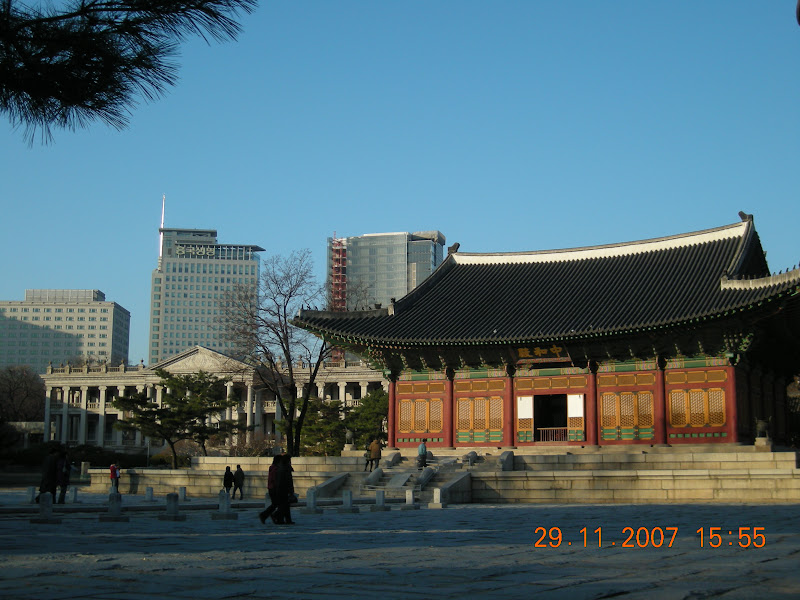
1) jeukjodangjeukjodang with downtown skyscrapers as a backdrop.
three korean monarchs ascended the throne here. the throne room and audience hall is set atop a broad, 2-tiered stone terrace guarded by two tiger-ish mythical folk animals, called haetae. the original structure was larger and had two roofs (burned in 1904).
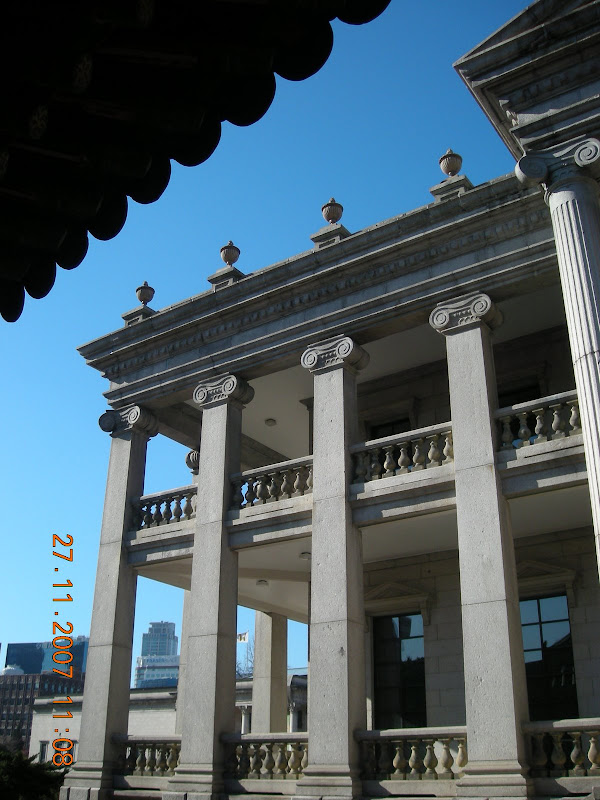
2) seokjojeonseokjojeon features a little western flourish alongside traditional joseon architecture.
built between 1900-09, it was designed by a brit, though construction was supervised by all sorts of folks. originally planned for gyeonghuigung, gojong received foreign envoys in the three-story, neo-classical building. today it's part of the royal museum.
3) jeonggwanheona quirky tea house.
this funky tea house was built in 1900 and designed by a russian. its iron railings are decorated with bats, deer and pine trees. gojong liked to listen to music, discuss current affairs, and drink coffee and tea here. tragically, it was also where his young son, the crown prince sunjong, drank an opium-laden drink intended for the king, which put the boy into a coma and resulted in brain damage.
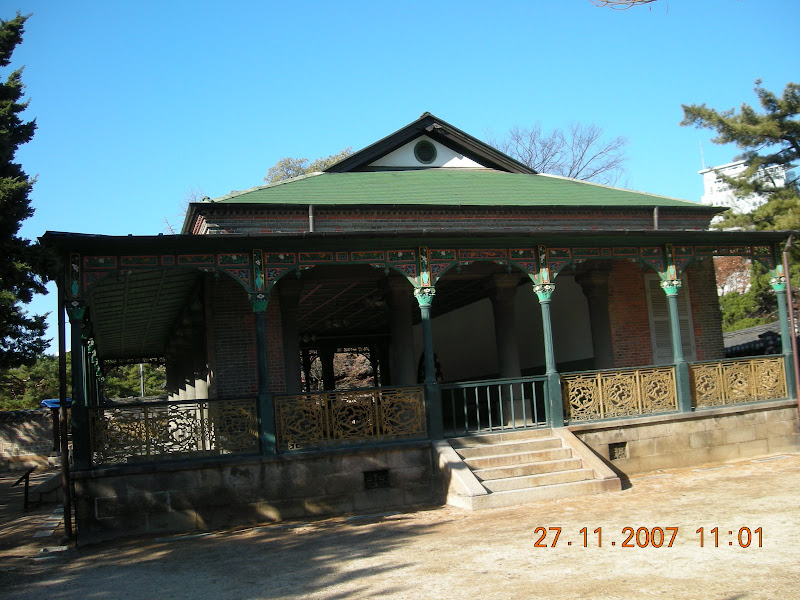
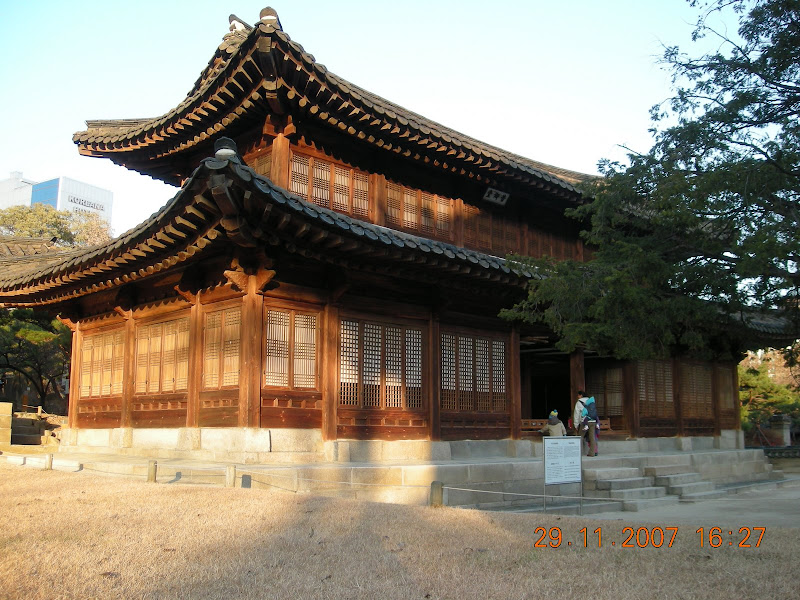 only royal or religious buildings could be painted in bright colors or feature rounded pillars.
if you visit deoksu palace, there's lots else to see too. the two-story seogeodang hall lacks the colorful paint and rounded pillars reserved for palaces and buddhist temples. the grounds also feature korea's first western-style garden and a large statue of king sejong the great. 3x daily on tues-sunday from february 15-december 31 watch hunky koreans dressed up like joseon-era soldiers re-enact a changing of the palace guard. maybe i'll come with you.
getting there:
→ take subway lines 1 or 2 to city hall station (exit #2). 1,000 won for adults, 500 won for youth and free for 65+, the disabled, and anyone who's clad in a traditional korean hanbok. open 09:00-21:00. free english guide tour tues-fri at 10:30 and on the weekends at 13:40. closed mondays.for more information:
a nicely-detailed historical account here.
more information and some great photos here.
official website here.
14 May 2008
cityplan #4: gwanghwamun plaza

the other day i had a sad moment as i stood outside exit #7 of the city hall subway station. to my faaar left i could see where seoul's "great south gate" should be, and to my faaaaarther right was where the grand gwangwha gate marks the entrance to seoul's largest royal palace, gyeongbukgung.
in a city this massive, seeing the ancient capital's center and southern entrance gave me my bearings. but thanks to an arsonist and a shoddy reconstruction, both gates were hidden inside huge boxes of scaffolding. to my left and right were two of seoul's greatest treasures concealed from sight. of course it's nice they'll be back soon, but there's something sad about 600-year-old structures being rebuilt from scratch. anyhow, i guess that's what happens when wood meets... the japanese, crazy old men, korean dictators, etc.
the gwangwhamun (gwangwha gate) was built in 1395, three years after king taejo moved korea's capital to seoul, thus founding the joseon dynasty. the gate marked the entrance to his royal palace (gyeongbukgung). in the ensuing six centuries plus 13 years, gwangwhamun has been through a lot:
gwangwhamun timeline:
1395: gwangwhamun is built by king taejo.in its future iteration, gwangwhamun will meet a 3/4-kilometer long (740 meters) and 34-meter wide public plaza. by eliminating 6 of 16 lanes on one of seoul's busiest thoroughfares, city officials' plan is to connect seoul's grandest joseon-era palace to the recently restored cheonggye stream. the plaza will include water features (of course) and better views of the palace and bugak mountain. the goal is to improve seoul's livability and help it get onto the UNESCO historic city list.
1592: 2 centuries after it's built, japan's hideyoshi destroys the gate, the palace and nearly every significant structure on the korean peninsula during his 7-year-long invasion.although gyeongbuk palace and the gwangwha gate were yet to be rebuilt at the time of this map (1750), it shows the street that will become gwangwhamun plaza (click for larger).
1867: 275 years later king gojong rebuilds the gate and gyeongbuk palace.the massive governor general's building was built to dwarf the administrative buildings of european colonial outposts in asia. where's the gate? (click for larger)
1926: while under japanese occupation, 85% of gyeongbuk palace's 330 buildings are destroyed. a huge administrative building for the japanese governor general is built behind the gate in a deliberate attempt to conceal what remains of the royal palace. gwangwhamun is moved, but ultimately spared, thanks in large part to the japanese art critic, yanagi muneyoshi.an errant bomb scores a direct hit (click for larger).
1950: korea is liberated in 1945 but five years later the gate is almost totally destroyed during the korean war.
1963: the gate is rebuilt by dictator park chung-hee, but inferior materials are used.
1996: following considerable public debate, the governor general building is demolished. seen by many as a painful reminder of japanese imperialism, its removal coincides with plans to move the gate 14.5 m south, 10.9 m west and turned 5.6 degrees clockwise to its original location.a colorful box encases the gate during its reconstruction. gyeongbuk palace and bugak mountain are in the background (click for larger).
2006: renovations on the gate begin and designs are accepted for the development of a large public plaza.the city solicited design ideas from the public and these were the top 5 (click for larger).
april 2008: construction on the plaza begins.two images of the plaza's final design. apparently there's a party (click for larger).
june 2009 the gate and a new plaza is scheduled for completion.


 two korean studs.
per usual, there's been some controversy. an impressive statue of admiral yi, korea's greatest naval hero, stands in a landscaped island in the middle of the street where the plaza will be built. a seated statue of korea's #1 monarch, king sejong, however, was removed and currently rests in deoksu palace. since the restored gate and the palace it protects are reminders of the joseon dynasty days and because the street leading up to gwangwhamun is named sejong-no (after the king), some say the statues should be swapped. current plans, however, are to leave yi be and move the king beside the plaza in front of the performing arts center that also bears his name.
in any event, in the next couple of years, the giant boxes that surround both gwangwhamun and sungnyemun will be removed and two of the grand bookends of central seoul will once again be revealed.
30 April 2008
"thanks for discovering korea with me..."

lately, i seem to have come into the good graces of my bosses at kbs world radio. per usual, i'm not sure why but it's better than the equally inexplicable times when they hate me. but so desperate am i for constructive criticism, that i've obeyed my producer's request to make my voice two octaves higher than what's natural. that, in combination with non-sensical overblown intonation makes me sound like a penis-less sociopath, which makes him smile and give me compliments, so i keep doing it.
perhaps to reward my swallowed pride, they've given me a new show, called "discovering korea with matt kelley" (the "with matt kelley" was an amusing surprise). starting last week, every saturday, i'll do a 3-5 minute snapshot of some spot of the korean peninsula. the clever among you will recognize that this sounds an awful lot like my "field trips," but on a national scale. indeed. god help me i'm becoming a professional travel writer!
i'm happy because it's a convenient complement to my travel-related blog posts and a great excuse to do more exploring... err discovering. plus, it's fun to host a (very brief) show that i've also written, instead of just reading someone else's copy. but most of all, i like saying at the end of every piece, "i hope you enjoyed discovering korea with me," at which point i make pouty lips as the camera zooms in. with any luck, a well-timed breeze will hike my skirt and then i can expose a li'l leg.
if you fancy brief sketches of places in korea, you can read the transcript of previous shows here, and if you're on a pc, you can listen to the show online. it's part of saturday's "worldwide friendship" program. if you write in to my producers to say just how much you enjoyed traveling with matt kelley, they'll probably let me host in a one-piece lycra number next month, in which case, everybody wins.
22 April 2008
field trip #11: the cheonggyecheon (청계천)

much has been written about the cheonggyecheon (청계천), the 5.8-km restored stream that magically starts in the heart of downtown seoul and courses through the neighborhoods of jongno and dongdaemun before it meets the jungnangcheon (중랑천) and eventually empties into the han river. a snapshot i took on a nice day last fall when i skipping korean class.
completed in 2005, the restoration of the historic waterway was a major success for then seoul mayor (now president) lee myung-bak. it gave the former hyundai construction executive international plaudits and "green" credentials as the cheonggycheon was regarded by many as a major success in urban renewal and beautification. but beauty didn't come cheap. the initial price tag was estimated to be 900 billion won (approx. $900 million), but an additional $12 trillion won is expected to redevelop the adjacent neighborhoods into major commercial and residential areas.
although recent history saw the cheonggyecheon paved over by a concrete expressway, the "clean stream" as the translation goes, is older than the 600-year-old city itself. before seoul (then hanyang) became the joseon dynasty's capital in the late 14th century, the cheonggyecheon (originally known simply as "gaecheon" or "a stream") was one of several naturally formed streams that drained the ring of mountains into the han river. in 1406, king taejong ordered the stream dredged to temper the seasonal flooding that plagued his new fortress city's residents. although its geomantic value (known in korean as pungsu) suggested the stream should be kept clean, from early days until recently, practicality made the cheonggyecheon a primary way to dispose of wastewater.
during the japanese colonial period, the stream was renamed "cheonggyecheon" and became the border between the jongno neighborhood and honmachi, a japanese town. following liberation in 1945 and the korean civil war (1950-53), the area became a large slum. soon, the "clean stream" was filled with human waste, trash and rising sediment and emitted a pervasive stench. later that decade, as seoul began its rapid industrialization, the stream was paved over and the slums were destroyed. in 1968, an elevated highway was constructed over the old streambed, and in the 80s and 90s, the area became the noisy and dusty commercial center of seoul.
in 2003, with an eye towards making seoul a more environmentally-friendly and livable city, the cheonggyecheon restoration project got underway. and, nearly three years since completion, the cheonggyecheon is widely viewed as a big success. that said, the project caused considerable opposition and controversy by displaced merchants and a previous mayor, who feared (rightly so) that the project would accelerate gentrification in the area. furthermore, a few months prior to its completion, then-mayor lee myung bak's vice mayor and another political hack were arrested on bribery charges in connection with the project.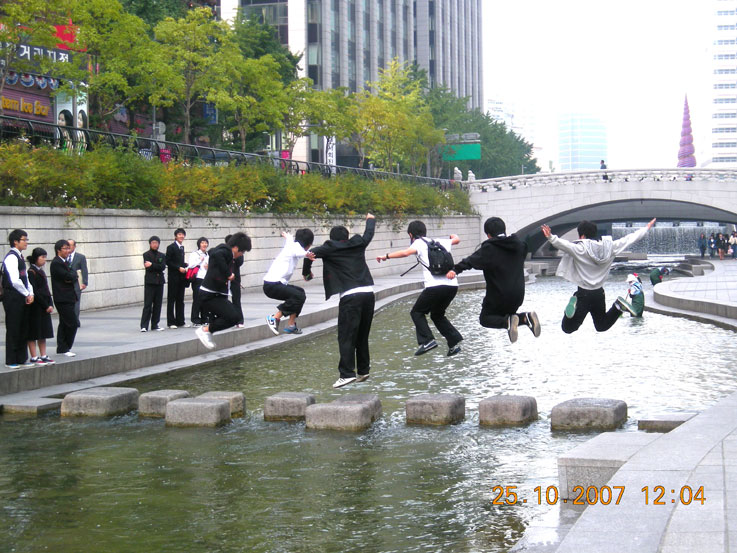 kids are cute.
nowadays, each week, over 500,000 people walk alongside the 120,000 tons of water that are pumped into the old streambed. in the mornings, groups of brightly-clad ajummas powerwalk along the paths while lovebirds walk slowly arm-in-arm at night when the banks are lit up. there's also a growing number of fish and birds returning to the stream, including a few bright orange goldfish i saw on a recent trip... no doubt the stream has become a favorite place for kids to release their pets.
anyhow, if you plan to make a visit, interspersed among the route's 22 bridges are several sights worth mention:


cheonggye plaza
this plaza marks the cheonggyecheon's starting point. a colorful spiral sculpture, a miniature etching of the stream, and a grand waterfall and fountain meet stones from eight provinces symbolizing harmony and eventual korean reunification.
location: prior to mojeon bridge (#1)
gwangtonggyo
this ancient bridge was built during the early joseon dynasty and was the ancient city's largest stone bridge. its current placement is approx. 150m from its original location.
location: it is bridge #2
banchado
a 192-meter long illustration of a visit by king jeongjo to suwon castle, painted on 5,120 ceramic tiles.
location: between gwang (#3) and samil (#5) bridges.
laundry site
this laundry site is a reminder of the stream's value for ordinary citizens for centuries.
location: between dasan (#16) and yeongdo (#17) bridges.
wall of hopes
20,000 citizens decorated 10 x 10 cm ceramic tiles with written wishes and drawings that decorate both sides of the stream.
location: between hwanghak (#18) and biudang (#19) bridges
jonchigyogak
these remaining piers are all that's left of the ugly old expressway that was replaced. it's one of my favorite elements.
location: just before muhak bridge (#20)
cheonggycheon culture center
a 6-story structure featuring an seminar rooms and exhibits on the stream's past and present.
location: straddling gosanja bridge (#22)
willow wetland
a wetland reclamation area featuring pussy willows, river bulrush and iris was planted to secure habitats for fish, birds and amphibians.
location: after gosanja bridge (#22)
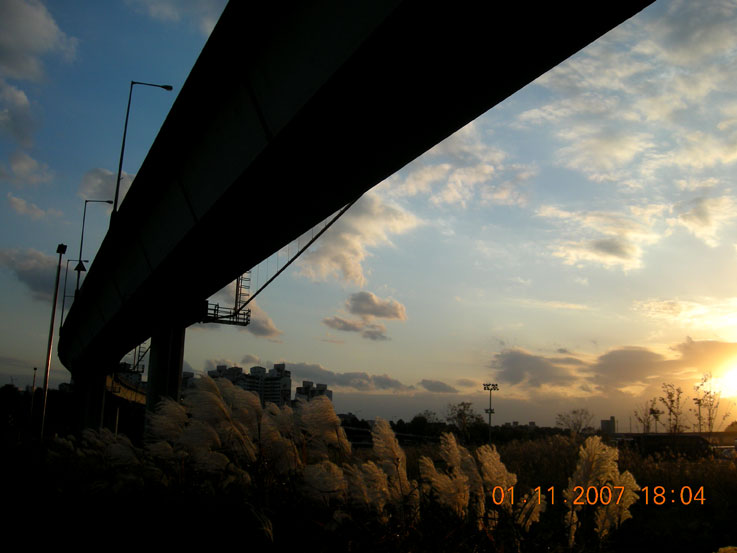 sunset near where the cheonggyecheon and jungnangcheon meet.
getting there:
→ take subway line 1 or 2 to city hall station (exit #4). walk 250m north to cheonggye plaza.
→ take subway line 5 to gwangwhamun station (exit #5). walk 100m south to cheonggye plaza.
→ note: subway line 1 runs along much of the stream's north bank from city hall station to sinseol-dong station. subway line 2 runs along much of the stream's south bank from city hall station to hanyang university station, as well as along its east bank.
10 April 2008
field trip #10: edae

i usually say that i live in sinchon, but my apartment is more precisely situated on the western edge of edae, a patch of western seoul anchored by ewha womans (sic) university. beyond the campus is a funky grid of narrow, car-unfriendly alleys packed with cheap hole-in-the-wall restaurants, clothing boutiques and other businesses popular among elite young women, like cafés, cosmetics stores, and beauty salons that advertise their connection to former miss korea's. walk east and you'll pass over 100 wedding boutiques (although the school didn't allow married women to enroll until 2003).
like its customers, edae prefers to wake up late and stay up late. each morning, when a steady line of women walk the half-kilometer from edae subway station towards campus, most of the shops on "fashion street" are still shuttered. but on the weekends, shops stay open past 11 pm when the alleys are packed tightly with young couples and packs of (mostly female) shoppers shop while munching on street meat. but, like everywhere else in this city it seems, edae is undergoing significant changes. just 2 years ago, several dozen 1-4 story buildings stood where a huge yes apm department store/residential tower does today. more consolidation is on the way.
the neighborhood's namesake has also underwent big physical changes. founded 120 years ago by methodist missionaries, ewha is the world's largest university for women (lucky me!). the name "ewha" means "pear blossom" and was bestowed by korea's emperor kojong. the campus' 74 buildings are considered by many to be korea's most beautiful college.

for several years, the distinguished campus endured heavy construction, but now ewha students are enjoying the ewha campus center (ecc), an ambitious 3-year, 100-billion won ($102 million) project designed by paris-based architect, dominique perrault. the 66,000 square meter, 5-level structure is mostly underground, but a 25-meter-wide, 250-meter-long "campus valley" cuts through the center of the gently sloping hillside. the valley floor is granite and two high walls of steel and glass lead you towards a long granite staircase. the structure's roof is covered in trees, newly-planted grass, and jagged stone paths.
opened in early march, the airy and impressive (tho still unfinished) ecc contains a library, cafeteria, fitness center, 40 seminar rooms, parking, administrative and sleeping rooms, as well as a 774-seat performance theater. formerly the site of ewha square and an athletic field, the site is the university's largest open space and its primary link with the surrounding neighborhood. according to one description, "it will establish organic relations between the center and surrounding areas of campus as well as between above ground and underground spaces." given the poor design or execution of many projects of this kind, i'm pretty impressed with the outcome.
getting there:→ take subway line 2 to edae station (exit #1 or 2). walk north. to your left and right are edae's many shops. about 0.5 km ahead you'll meet ewha womans university's main gate and the ecc will be in view.
→ or, take one of several busses that go to sinchon train station (153) and walk east 0.25 km.
28 March 2008
seoul walking tour
the royal asiatic society's korea branch (raskb) offers an impressive number of english-language tours and lectures in korea and elsewhere. last october i attended my first raskb event: a talk about early depictions of korea in western maps. yum. this past week i went to see mr. a lin neumann, chief editor of the joongang daily, discuss some of the challenges of integrating u.s. style journalism in a korean newsroom (isn't korea... amazing?!)
anyhow, on sunday i'll partake in my first raskb walking tour of seoul. i'll follow expert peter bartholomew as he explains the cultural and historical background of seoul palaces, joseon-dynasty landmarks and recently-excavated royal treasures. he'll explain the 600-year-old capital's layout and history. from my brief interactions with him thus far, he's a kind older american canadian (sorry) gentleman with a sincere affection for korean history and culture. it's from 9 am to 3:30 pm, only 15,000 won, and mr. bartholomew comes highly recommended.
let me know if you want to meet up!
24 March 2008
cityplan #3: new city hall

i've been a bad blogger lately. sorry.
last month's tragic arson of sungnyemun focused considerable criticism at seoul's cultural heritage administration for its lax security of the nation's #1 national treasure. but the preservation group has also been dogged for its role in delaying construction of a new city hall for seoul.

the cha played hardball and rejected several designs before approving an october 2007 master plan. that version, however, was ill-received by the public for being architecturally incongruous with nearby deoksu palace. in response, the seoul metropolitan government invited four renowned korean architects to "remodel" the design. with the cha's reputation in tatters, one week after sungnyemun was destroyed the master plan for seoul's new city hall was approved. construction on the 13-floor, 941,000 square meter complex should begin any day now with completion set for 2011.
earlier designs were inspired by feminine curves (!) or the taeguk (the yinyang symbol on korea's flag), but the korea herald says that the new design will "feature a blend of traditional design such as the curves and shades of traditional [korean roof] eaves." hmmm. this design is many things, but "traditional" it ain't. anyhow, the building's curved design will also be incorporated into the grounds via a dozen "waves" on the city hall lawn. reportedly 30% of the new building will be set aside for "cultural space," which includes a "sky lounge." (why does every new building in seoul have a "sky lounge"? ...what is a "sky lounge"?)
the current city hall is itself controversial. built of gray faux-stone in 1926 during the japanese occupation, it has been seen by some as a painful reminder of foreign imperialism, prompting calls for its demolition. unlike the former presidential house, city hall escaped the wrecking ball. but the public's mixed feelings of the place seems to have inspired its planned annex. the new building looks poised to pummel the original structure tsunami-style. one expat blogger remarked that it was as if the korean pop-culture wave (한류) was swallowing up japan.
the current city hall will be converted into a public library and information center.
here's an earlier post i made about an earlier city hall redesign.
10 March 2008
field trip #9: sinchon love hotels


sinchon's main drag is a busy 8-laner with seoul metro's line 2 running below it. the 1-km span from edae station to the 5-way sinchon rotary and subway station is flanked by high-rise office-tels (speaking of konglish, this one is hard to explain), a movie theater, department stores and several english language hagwons (institutes). but if you move just one block north of main street, you'll find a long, uneven and quiet alley. on either side are ugly low-rise brick homes, one-room restaurants, ha-sook jibs (student housing), and at least 40 "love motels", starting with "motel good time" on one end all the way to "hotel reem" at the other. choose your pleasure.
back in the day, my neighborhood was supposedly a small but notorious red light district popular with american soldiers. although "club 88 sexyland" and "sexy han bar: always on my mind" are still outside my door, and apparently on my mind, sinchon doesn't feel especially seedy. while it's obvious why the love motels charge by the hour, they're not brothels.
the popularity of love motels is in part a response to korea's stubborn confucian culture. it's estimated that less than 5% of korean couples live together before marriage. since the vast majority of korean young people stay with their parents until marriage, it's typical for korean men and women in their late 20s to remain under their parents' roofs. love motels provide young love birds (and adulterers, alike) a clean and comfortable place to perform their shenanigans.
the love motel phenomenon is better known in japan, and the nihons will take themed-anything to its extreme. tho less remarkable, korean love motels are quite kitschy, flaunting a "cheapo fancy" vibe a la christmas lights year-round, neon signage, plastic flowers, very few windows and building materials usually consisting of glossy synthetics that won't last long. discretion is a primary concern, so some love motels have touch screen self-check-in. most hang vinyl curtains to conceal patrons' faces. if that's insufficient, some garages kindly conceal your car's license plates just in case your spouse is lurking about the neighborhood.
inside, the rooms are usually clean and pleasant. amenities typically include dvd players, internet and large lcd tvs with cable. many rooms have jacuzzis and, in case you forgot where you were, vending machines that sell condoms, lube, breath strips, toothbrushes, sex toys, etc. i saw a few motels advertise the availability of online multi-user role playing games, like world of warcraft. sounds like a girlfriend's worst nightmare.
my favorite aspect of love motels is their names, which are exclusively in konglish and try to evoke either 1) the hifalutin life: e.g. motel paradise, royal park, noblesse and hotel luxury, 2) sexual innuendo: motel touch, boom, eros, reem, and good time, or, 3) lost in translation: masstige motel chic, hotel echae and e'zen hotel (electronic zen? ease-in?). my favorite is a little place half-way up the hill called motel eegee (korean pronunciation of "easy"). i'd like to hope that i'd be offended if my date took me to motel easy.
if he did, however, chances are the night would run about $50, which isn't bad for a clean and comfortable room. a tip: if you don't want to be surrounded by (other peoples') sex sounds all night, choose a motel a few doors off the main drag.
getting there:→ if you want to see sinchon's love motel strip for yourself, take subway line 2 to sinchon station (exit #3). walk away from the rotary but veer right at first opportunity to wander off main path.
→ or, take one of several busses that go to sinchon rotary (153).
